Industry Resume
My industry resume can be found here.
Projects
Two portfolio projects applying robust optimization and saddle-point algorithms to supply-chain planning. Both use synthetic data only and are not based on any company’s proprietary data or systems.
Robust Middle-Mile Capacity Planning under Demand Uncertainty
GitHub repository · Python, NumPy, SciPy, Matplotlib
Problem. A transportation planner must reserve lane-level carrying capacity before freight demand is known. Too little capacity causes shortages and service failures; too much wastes reservation cost.
Approach.
- Built a synthetic middle-mile network (8 facilities, 18 directed lanes, 7 days) with correlated demand scenarios, and compared nominal, expected-value, and min-max robust capacity plans.
- Reformulated the robust plan as a convex-concave saddle-point problem (adversarial weighting of demand scenarios) and solved it with a projected extragradient method, validated against an independent SciPy epigraph solve.
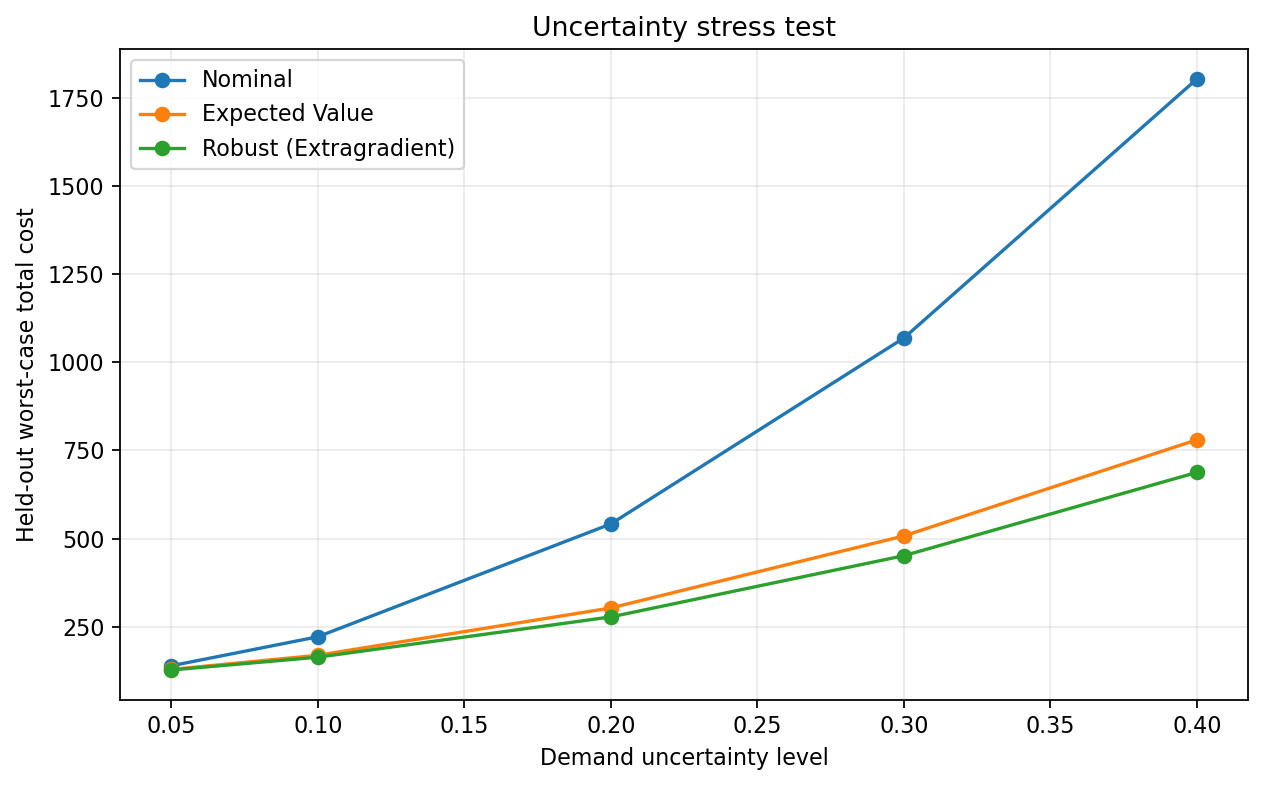
- Evaluated every plan on 500 held-out test scenarios and an uncertainty stress test.
Results.
- Versus expected-value planning, the robust plan reserved 3.7% more capacity, cut mean shortage by 19.9%, and raised service level from 97.86% to 98.28%.
- At the highest uncertainty level tested, it reduced the worst held-out cost by 11.8% for about 4.1% more capacity.
- Extragradient matched the reference objective to a relative gap below $10^{-7}$ in every stress-test instance, while plain gradient descent-ascent stalled.
Robust Fulfillment-Center Labor Allocation under Workload Uncertainty
GitHub repository · Python, NumPy, SciPy, Pandas, Matplotlib
Problem. Intraday labor must be assigned to Stow, Pick, Pack, and Ship before workload is known. Lean staffing saves labor cost but creates backlog when volume spikes or productivity drops.
Approach.
- Modeled hourly staffing over 12 periods with labor, reassignment-friction, and backlog-penalty costs under a shared workforce cap.
- Solved the min-max robust staffing plan with projected extragradient, using an exact projection onto the capped workforce set and onto the probability simplex.
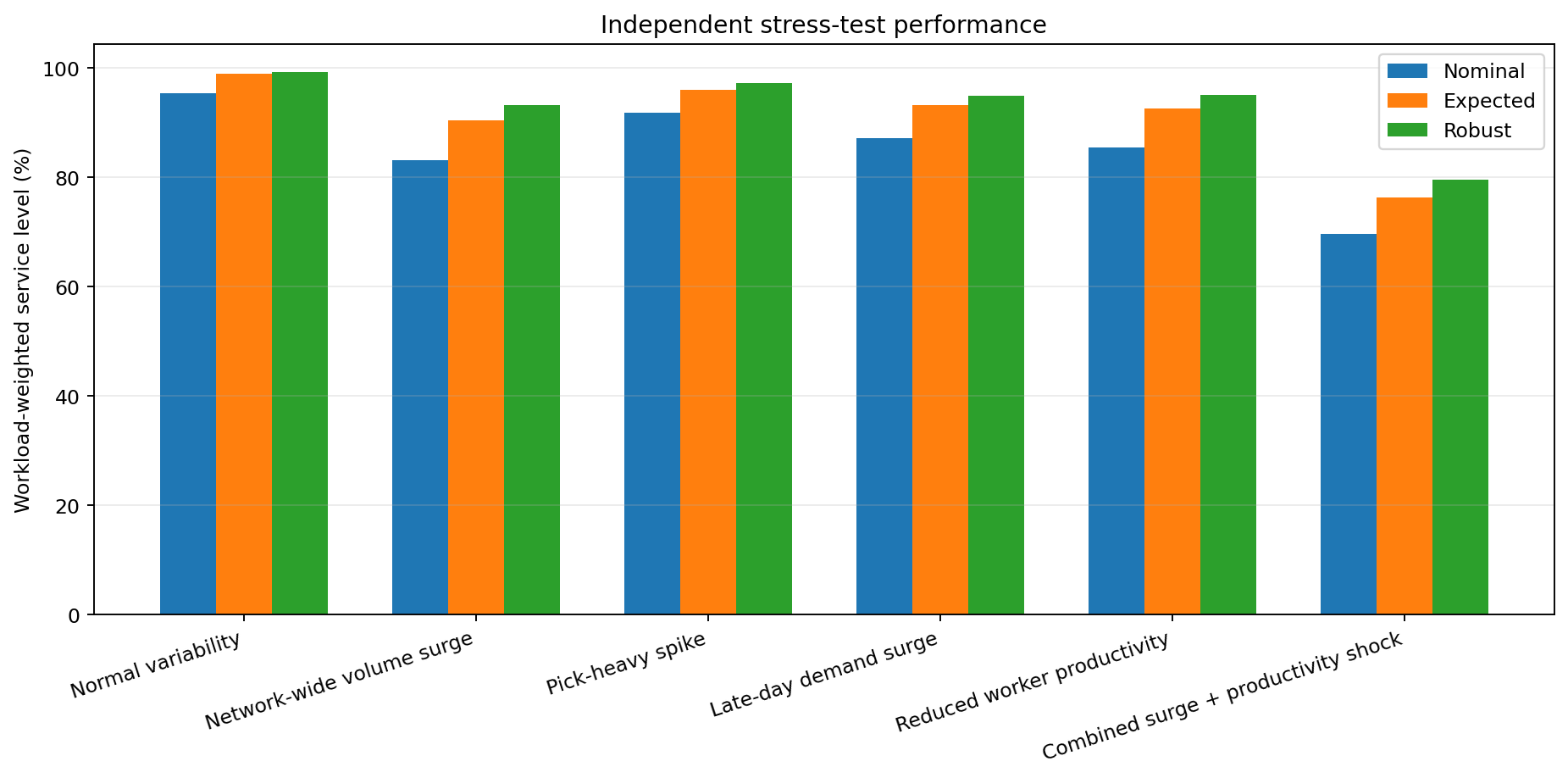
- Stress-tested fixed plans on 1,200 independent scenarios across six regimes: normal variability, volume surge, Pick-heavy spike, late-day surge, reduced productivity, and a combined shock.
Results.
- Versus expected-value planning, robust staffing cost 4.57% more labor but cut average shortage by 21.56% and worst-case loss by 10.64%, raising service level by 1.98 percentage points across the stress suite.
- Under a combined volume and productivity shock, service level was 79.51% (robust) versus 76.33% (expected-value) and 69.67% (nominal).
- The robust solution matched an independent SciPy reference to a relative gap of about $4 \times 10^{-8}$.